Does Volunteer Work Count as Work Experience?
Career & Workforce Readiness
Yes, volunteer work can count as work experience on a résumé or job application. What matters is the work you did and how it connects to the position. Label it as volunteer experience, and check whether the employer has specific requirements about paid work, hours, or qualifications. www.dol.gov
If you’ve been leaving it off your résumé because nobody handed you a paycheck, you may be overlooking work you actually did.
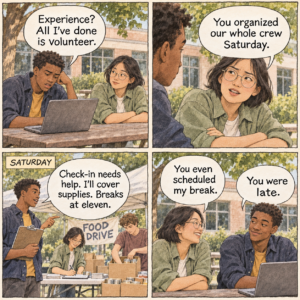
Maybe you spent the summer helping at a community center. You arrived before the program started, got materials ready, answered questions, and helped the staff keep a room full of children moving in roughly the same direction. Some days went smoothly. Other days, you learned why the staff kept a spare set of everything.
Then a job application asks about experience, and you write, “None.”
Before you settle on that answer, think about what people trusted you to do. You had a schedule to follow, responsibilities to handle, and people counting on you. Calling it “just helping out” can leave a lot of that out.
How can volunteering help you gain work experience?
Volunteering can give you practice in a field you’re interested in working in or studying. Choose an opportunity with your future in mind.
If you’re interested in teaching, helping with a tutoring or after-school program could give you a closer look at working with students. If business interests you, a nonprofit fundraiser might give you practice with registration, supplies, recordkeeping, or talking with the public. You’re helping an organization do something it needs done while learning about work you might want to pursue. www.choosework.ssa.gov
Ask what the role involves before you sign up. “What would I be helping with?” and “Would I have a chance to learn about this part of the work?” are perfectly reasonable questions. The name of the organization only tells you so much. The responsibilities tell you what you’ll get to practice.
This is how you can start preparing earlier. By the time you’re choosing classes or applying for paid work, you may have seen some of the daily routine, worked alongside people in the field, and found questions you wouldn’t have known to ask before.
You can explain what you’ve tried and why you want to keep learning. That gives you something to build on when your interests, goals, and experience begin to line up.
And sometimes you discover you don’t enjoy the work as much as you expected. That’s useful to find out, too. An interest can look different once you’ve spent a few afternoons doing something connected to it.
What skills can you gain from volunteering?
Volunteering can help you build leadership, communication, teamwork, planning, and problem-solving skills. You may use those abilities in jobs that have little to do with the place you volunteered. www.choosework.ssa.gov
Say you helped organize a food drive, and now you’re applying for an office job or a recreation position. You might assume the food drive has nothing to do with either one.
But what did you do there?
Maybe you kept track of supplies, explained assignments, or helped new volunteers understand the process. Perhaps two people didn’t show up, and you helped the group adjust so the work still got done. If you led that effort, you have an example of leadership. If you worked through a disagreement or explained something clearly to a frustrated person, there’s experience there, too.
These are often called transferable skills: abilities you can use in different jobs and settings. They can travel with you even when the field changes. dol.ny.gov
You might have picked them up while focusing on something else. That doesn’t make them minor. For a job that involves organizing people or helping customers, those skills could be a meaningful part of why an employer considers you.
The same applies if you’re returning to work. Volunteer responsibilities may give you recent examples of what you can do, even if it’s been a while since your last paid position.
How do you put volunteer work on a résumé?
List the organization, your volunteer role, the dates, and the responsibilities that connect to the job. Use an Experience or Volunteer Experience heading, and make it clear the role was unpaid. www.dol.gov
An employer wasn’t there with you, so help them understand the work.
“I volunteered at events” doesn’t explain much. If you welcomed visitors, checked registration lists, and showed new volunteers how to set up, say that. It gives someone a clearer picture of your responsibilities and something specific to ask about in an interview.
You don’t have to make yourself sound like you ran the whole organization. If you led a group, explain what you led. If you supported the person in charge, explain your part. Give yourself credit you can comfortably stand behind.
Read the application carefully, too. A posting may specifically require paid experience, certain credentials, or a particular amount of work. Check how your experience fits those requirements, and give your actual hours when asked. Volunteering occasionally over a year is different from working full time for a year.
Give yourself something to build on
You don’t need your whole future figured out to choose a useful place to start. Pick an area you’re curious about, ask where help is needed, and choose a commitment you can follow through on.
While you’re there, pay attention. Ask questions when the time is right. Keep a few notes about the responsibilities you take on and what you learn. Those details are easy to forget once “helped out over the summer” becomes your answer for everything.
That’s part of career readiness: learning about the work, knowing your skills, and being able to explain them.
Before you tell someone you have no experience, give yourself a fair look.